PetRoot
| Role | Cofounder, product, design, engineering |
|---|---|
| Platforms | iPhone, Android, web |
| Website | petroot.app ↗ |
| App Store | View on App Store ↗ |
Overview
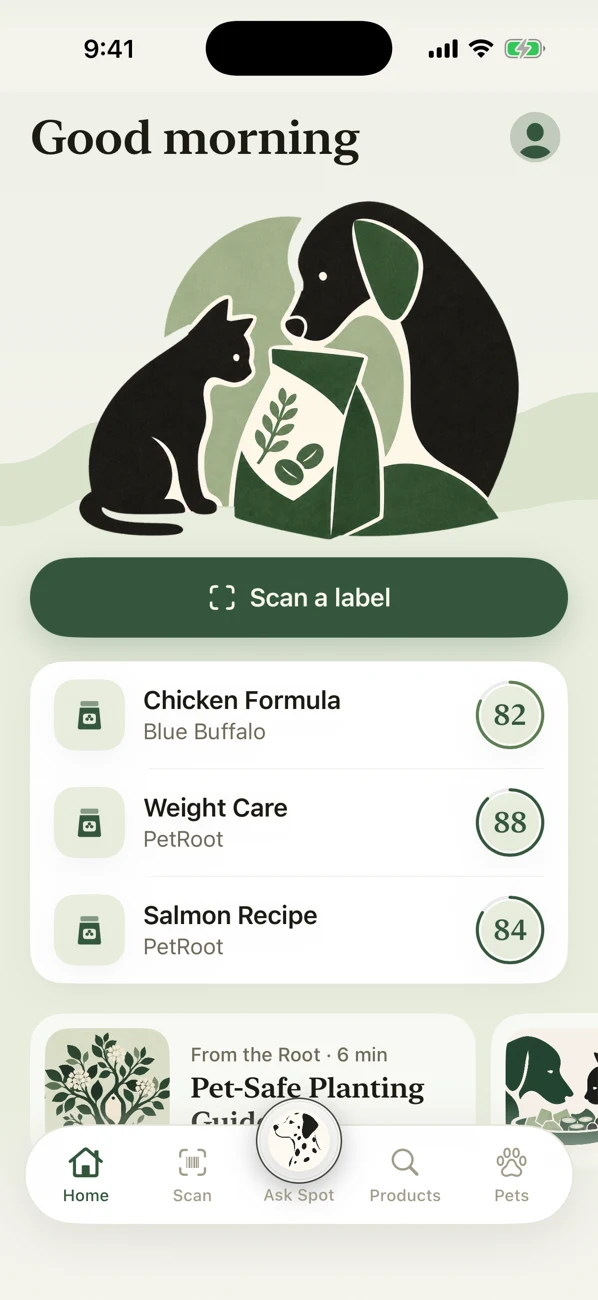
PetRoot is a collaboration with my partner Lauren, a former researcher at Colorado State University’s veterinary hospital. After she shared her idea for an app that could help answer questions about pet health and safety, we decided to launch PetRoot as a transparent, science-backed resource to help pet owners navigate an increasingly crowded product marketplace.
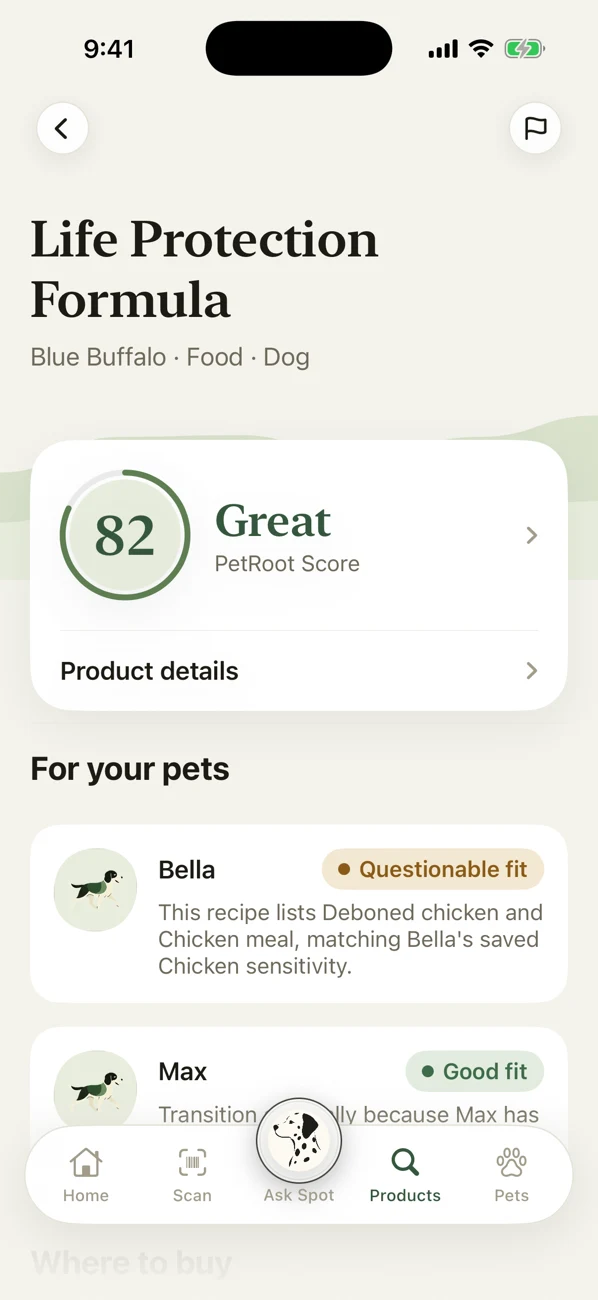
The core of the platform is the PetRoot Score: a deterministic scoring algorithm that gives consumers an easy-to-understand way to compare different products across food, treats, and toppers for dogs and cats. The score system is based on the findings of 166 papers across 56 journals, which I used to test both marketing claims and some of my own assumptions about pet food.
To calculate the Score, PetRoot estimates a recipe’s composition from ingredient ranges, ingredient order, guaranteed analysis, and the confidence of the underlying data. It then evaluates that estimate against factors such as AAFCO life-stage guidelines, amino acid profiles, and reliance on heavily processed starches. The result is a score traceable to a tenth of a point, with every contributing factor explained and the supporting research linked on the product page.
Our PetFit mechanism, which incorporates a specific pet’s breed, age, weight status, activity level, allergies, sensitivities, and medical conditions, as well as the owner’s own preferences, provides personalized verdicts (Good, Questionable, Avoid) for every product. PetFit also references studied breed and crossbreed conditions, like higher risk of urinary stones in Poodles, to inform recommendations; a Goldendoodle’s Poodle ancestry would be flagged on low-moisture foods, for example, due to this inherited propensity for urinary stones.
Spot, PetRoot’s AI assistant, answers questions about foods, plants, ingredients, and product recommendations through controlled internal tools backed by researched safety rules and defined database queries. Rather than letting the model improvise from training data or web search, I built separate core, adversarial, and quality evaluation suites around those workflows.
Platform architecture
Product surfaces
Shared API
Fastify + TypeScript
Authentication, request routing, domain services, and background jobs
Product systems
Data and evidence
Infrastructure
PostgreSQL + Kysely relational data
Railway API and workers
RevenueCat Apple and Google entitlements